
1. What Are Infrared Optoelectronic Components?
Infrared optoelectronic components are electronic devices that use infrared light to transmit, receive, detect or convert signals. Because infrared light is invisible, directional and suitable for non-contact detection, it is widely used in intelligent electronic systems.
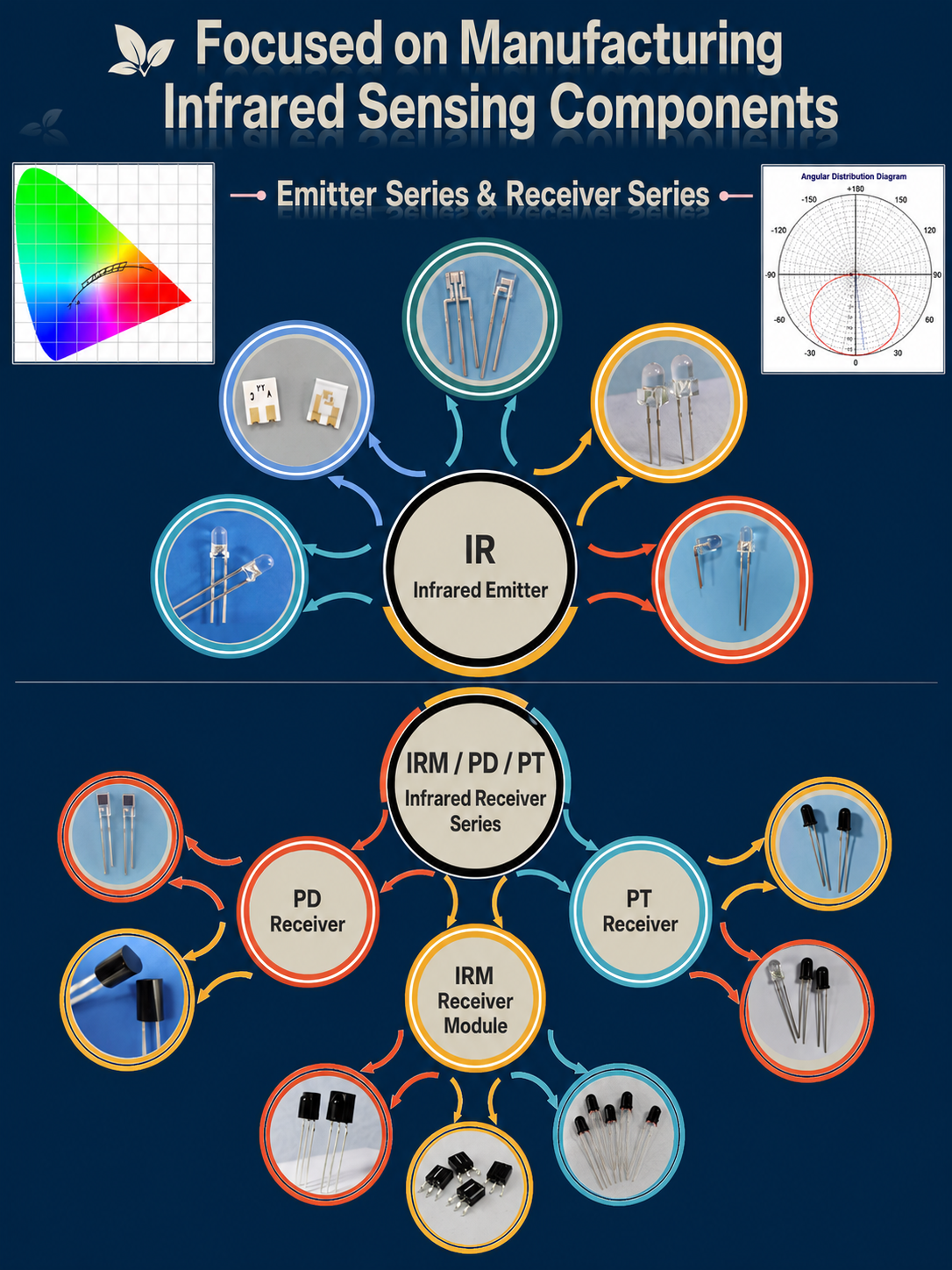
Common infrared optoelectronic products include:
- Infrared emitting diodes
- PD infrared photodiodes
- PT phototransistors
- Infrared remote-control receiver modules
- Light-emitting diodes
These components are usually integrated with control circuits, sensors or microprocessors to perform detection, remote control, alarm activation and data transmission.
2. The Role of Infrared Emitting Diodes
An infrared emitting diode converts an electrical signal into infrared light. Common wavelengths include 940nm and 850nm. Special wavelengths such as 730nm, 750nm, 880nm, 890nm and 905nm can also be produced for specific applications.
Different wavelengths are suitable for different systems. For example, 940nm infrared emitters are widely used in remote controls, home appliances and infrared sensing products. The 850nm wavelength is commonly selected for infrared illumination, surveillance equipment and certain machine-vision applications.
Package dimensions are another important consideration. Φ3 and Φ5 are common sizes, while customized housings can be developed when customers require a different installation structure, beam angle or operating distance.
3. How Infrared Receivers Enable Accurate Detection
Infrared receivers detect infrared light and convert it into electrical signals. The most common types are PD infrared photodiodes and PT phototransistors.
Their performance is generally determined by several factors:
- Sensitivity
- Response speed
- Product consistency
- Interference resistance
- Operating temperature range
Consistency is particularly important in mass production. Sorting products with professional spectral testing equipment helps reduce performance differences between individual components and production batches.
Infrared receivers with high sensitivity and strong interference resistance can be used in smoke alarms, pulse oximeter probes, security devices, automatic sensing systems and intelligent lighting products.
4. Advantages of Infrared Remote-Control Receiver Modules
An infrared receiver module detects modulated infrared signals and converts them into digital signals that can be processed by a control system.
Both through-hole and surface-mount versions are available for applications such as:
- Home appliance control boards
- Intelligent lighting systems
- Outdoor streetlights
- Set-top boxes and audiovisual equipment
- Industrial remote-control devices
- Smart-home control systems
A reliable infrared receiver module should provide a long receiving distance, strong resistance to ambient light, effective electromagnetic interference protection and stable high-temperature performance.
Products manufactured with heat-resistant materials are better suited to modern soldering processes and can reduce the risk of component damage during assembly.
5. Typical Applications of Infrared Components
Medical Monitoring
In pulse oximetry equipment, infrared emitters and receivers work together to collect optical signals for blood oxygen saturation and pulse analysis.
Security and Alarm Systems
Smoke detectors, infrared alarms and intrusion-detection devices use infrared signals to identify environmental changes and improve monitoring efficiency.
Smart Homes
Televisions, air conditioners, lighting systems and intelligent control panels use infrared receiver modules for remote operation and device coordination.
Intelligent Lighting
Infrared sensors can detect human movement or passing objects, allowing lights to switch on and off automatically while reducing energy consumption.
Industrial Automation
Infrared components can be used for position detection, object identification, counting, signal transmission and automated equipment control.
6. How to Select the Right Infrared Component
When selecting an infrared optoelectronic product, buyers should consider:
- Whether the wavelength matches the application
- Whether the emitting power and receiver sensitivity are compatible
- Whether the operating distance meets the system requirements
- Whether the product resists ambient light and electromagnetic interference
- Whether the package and pin structure fit the installation design
- Whether the component can withstand heat, humidity or outdoor conditions
- Whether batch-to-batch consistency is stable
- Whether customized products are available
For medical, security and other reliability-critical applications, traceability, long-term stability and quality-control procedures should receive particular attention.
7. Conclusion
Infrared optoelectronic components may be small, but they play an essential role in intelligent sensing systems. As smart-home products, medical electronics, security equipment and industrial automation continue to evolve, manufacturers require higher sensitivity, stronger consistency, greater reliability and more flexible customization.
Working with an experienced infrared component supplier can improve the reliability of finished products, shorten development cycles and provide more targeted solutions for different operating environments.