1. Why Supplier Selection Matters
Infrared emitters, photodetectors and remote-control receiver modules are usually installed inside finished equipment. Although an individual component may represent only a small portion of the total product cost, inconsistent performance can affect the operation of the complete system.
For example:
- Insufficient emitting power may reduce the remote-control distance.
- Inconsistent receiver sensitivity may cause unstable detection results.
- Poor ambient-light resistance may lead to false triggering outdoors.
- Inadequate heat resistance may cause damage during soldering.
- Large batch variations may increase calibration and after-sales costs.
For these reasons, buyers should evaluate more than price. Production, testing, management and service capabilities are equally important.
2. Evaluate Industry Experience
Stable performance is often the result of long-term technical experience. A supplier with extensive experience in infrared semiconductor manufacturing is more likely to understand the requirements for wavelength, beam angle, sensitivity, receiving distance and interference resistance.
An experienced supplier can usually:
- Analyze customer applications more efficiently
- Recommend suitable product models
- Identify potential design problems early
- Assist with circuit and structural optimization
- Suggest solutions for special operating environments
- Improve sample-development and mass-production efficiency
Industry experience is particularly valuable for medical monitoring, security alarms and other reliability-critical applications.
3. Review Production Equipment and Automation
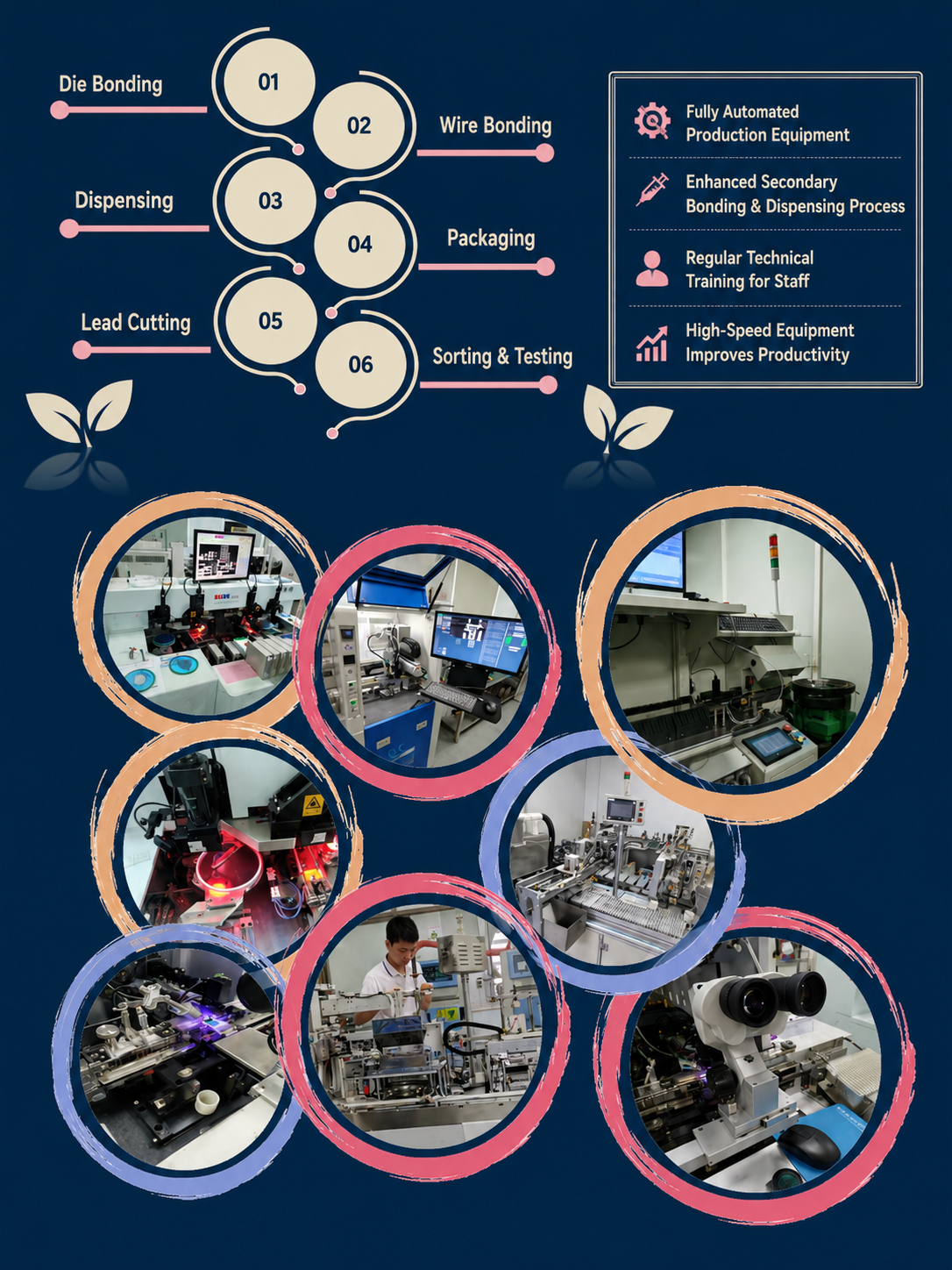
Professional manufacturing equipment is essential for maintaining accuracy and consistency. Infrared component production normally includes die bonding, wire bonding, encapsulation, spectral sorting, testing, lead forming and taping.
Important production equipment may include:
- Automatic die-bonding machines
- Automatic wire-bonding machines
- Encapsulation equipment
- Spectral sorting machines
- Automatic forming equipment
- Lead-bending and taping machines
- Computerized testing systems
Automation reduces variation caused by manual operations, improves efficiency and supports consistent mass production.
Buyers should also evaluate daily output, production scheduling and the supplier’s ability to handle urgent orders. Sufficient capacity reduces delivery risks and supports long-term cooperation.
4. Understand the Complete Quality-Control Process
A reliable infrared semiconductor supplier should maintain quality control throughout the entire production process.
A complete quality-management procedure normally includes:
Incoming Material Inspection
Chips, frames, encapsulation materials, leads and packaging materials should be inspected before production.
In-Process Inspection
Production conditions should be monitored during die bonding, wire bonding, encapsulation and forming.
Performance Testing
Products should be tested for wavelength, optical output, sensitivity, response speed, operating voltage and receiving distance.
Spectral Sorting
Professional sorting equipment should classify components according to their performance parameters and improve batch consistency.
Finished-Product Inspection
Appearance, dimensions, electrical characteristics and optical performance should be checked before packaging.
Pre-Shipment Inspection
Before delivery, the supplier should confirm the product model, quantity, packaging and inspection results.
A traceability system is also important because it allows production batches, materials and test records to be identified when a quality issue occurs.
5. Check Certifications and Management Systems
ISO certifications can indicate whether a company follows standardized procedures for quality, environmental protection and occupational safety.
Buyers may review whether the supplier has obtained:
- ISO 9001 Quality Management System certification
- ISO 14001 Environmental Management System certification
- ISO 45001 Occupational Health and Safety Management System certification
Certifications do not replace product testing, but they provide useful evidence of structured management. For customers requiring long-term supply, standardized systems can reduce operational and quality risks.
6. Determine Whether Customization Is Available
Customers often have different product structures, operating environments and technical requirements. Standard components may not satisfy every application.
A supplier with an experienced engineering team may provide:
- Customized wavelengths
- Special package dimensions
- Adjusted emitting angles
- Optimized receiving distances
- Sensitivity-level sorting
- Heat-resistant material options
- Customized leads and package structures
- Sample development and tooling services
Professional customization involves more than changing the appearance of a product. It requires a complete evaluation of the circuit, installation space, operating environment and required performance.
7. Examine Product Consistency and Reliability
A high-performing sample does not guarantee that every component in mass production will perform in the same way. Buyers should therefore examine how the supplier controls consistency.
Useful questions include:
- Are all products spectrally sorted?
- Are production and testing records retained?
- Are aging or reliability tests performed?
- What is the acceptable parameter variation between batches?
- Can the supplier provide inspection reports?
- Can production batches be traced quickly when problems occur?
For medical monitoring devices, smoke alarms and security equipment, long-term stability is often more important than a single high-performance specification.
8. Evaluate Technical Support and Communication
A reliable supplier should offer more than physical products. Continuous technical assistance is also important.
Professional support may include:
- Fast responses to product inquiries
- Assistance with specification confirmation
- Sample-testing support
- Product adjustments based on test results
- Production progress updates
- Rapid handling of quality issues
- Support for future product upgrades
Efficient communication reduces misunderstandings, shortens the sample-confirmation process and helps projects move smoothly into mass production.
9. Do Not Make a Decision Based Only on Price
Low-priced products may reduce purchasing costs initially. However, inconsistent performance, high failure rates or unstable delivery can increase inspection, rework, after-sales and customer-complaint expenses.
A supplier should be evaluated according to:
- Product quality
- Technical performance
- Production capacity
- Testing capability
- Certifications
- Engineering support
- Delivery reliability
- After-sales service
- Total cost of ownership
A valuable supplier helps reduce costs throughout the complete product lifecycle rather than simply offering the lowest unit price.
10. Conclusion
Selecting an infrared semiconductor component supplier is an important part of product development and supply-chain management. Professional production equipment, complete quality control, stable manufacturing capacity, standardized management systems and flexible customization determine whether a supplier can support long-term business growth.
Before placing a large-volume order, buyers should verify the supplier through sample testing, factory evaluation, quality-document review and pilot production. Establishing a long-term relationship with a reliable supplier can improve product stability, shorten delivery times and provide continuous support for future product development.